Freya Klein · 23 September 2026
Sand Waves Beneath Desert Surfaces: Their Contribution to Global Carbon Storage
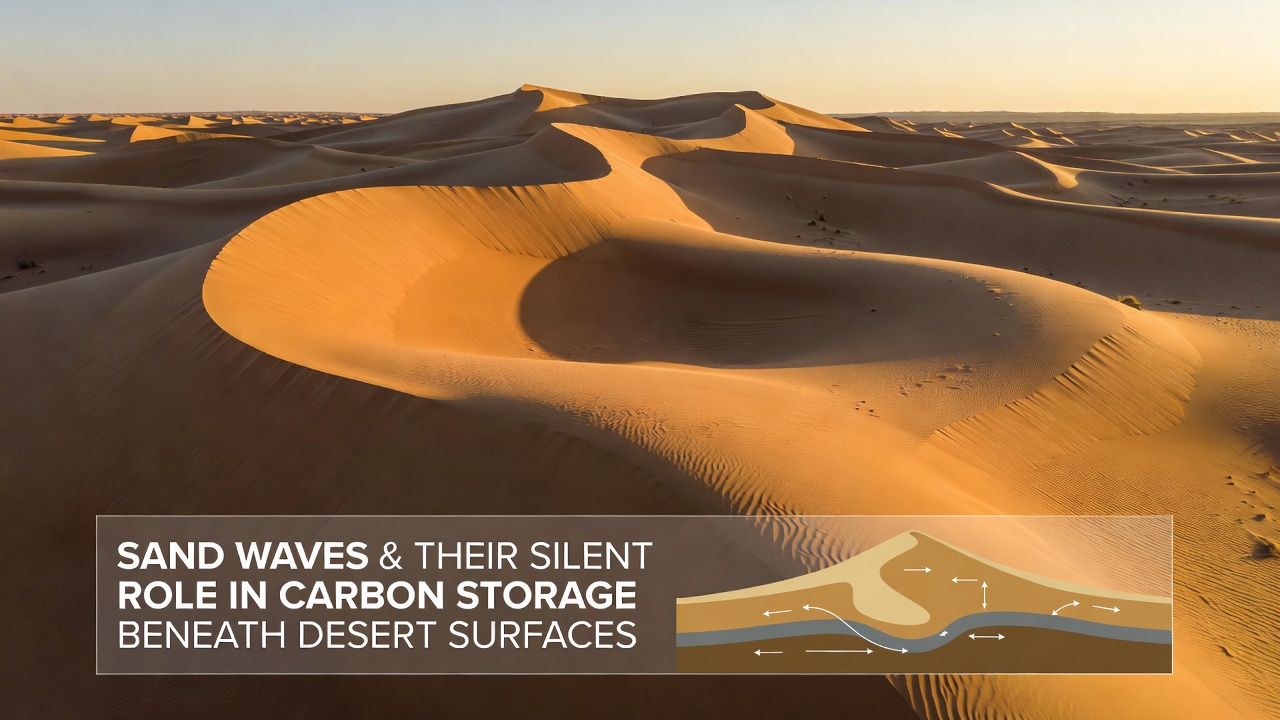
Desert sand waves, those vast undulating patterns formed by wind and gravity, shape landscapes across arid regions from the Sahara to the Australian outback, and researchers have documented their influence on subsurface carbon dynamics in multiple field studies. These formations migrate slowly over time, burying and exposing layers of sediment that contain organic material deposited during wetter climatic periods or transported from surrounding ecosystems, while data from long-term monitoring sites indicate that the burial process can isolate carbon compounds from atmospheric exposure for centuries.
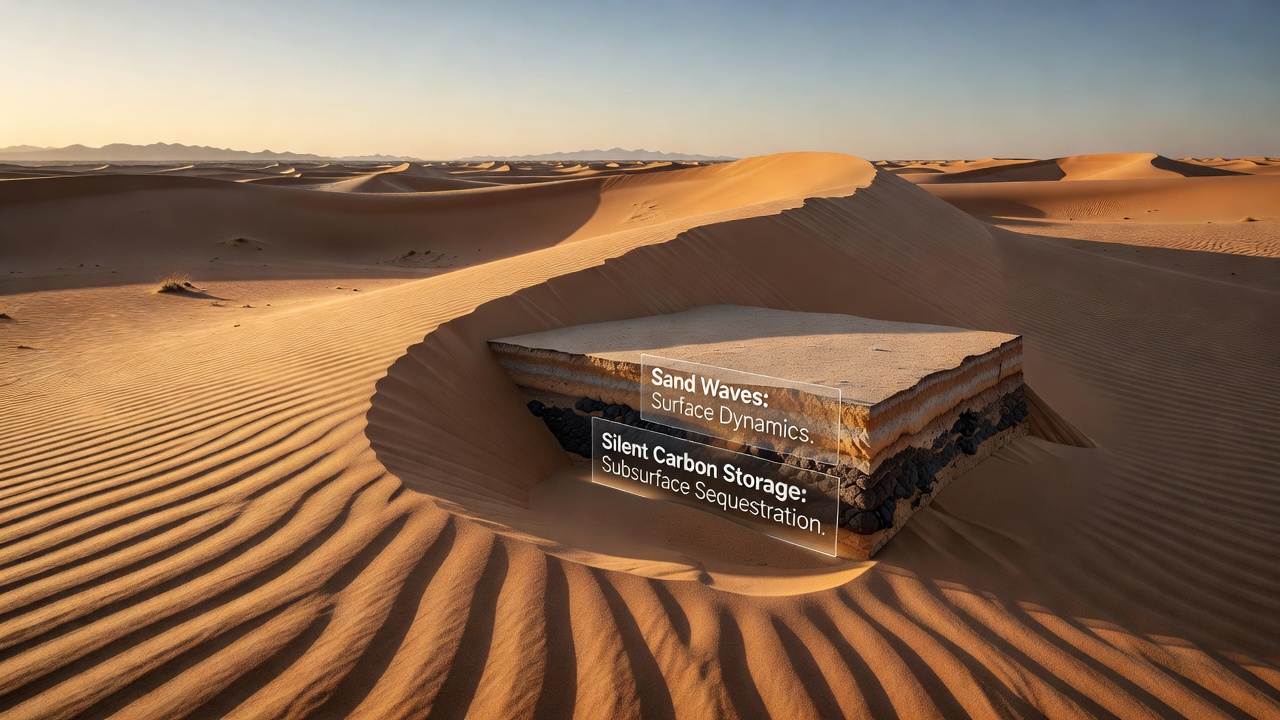
Scientists at institutions including the Desert Research Institute have measured soil profiles under active dune fields and found that carbon concentrations often increase at depths between 30 and 150 centimeters, where reduced oxygen levels and lower microbial activity slow decomposition rates. Sand waves contribute to this pattern because their movement creates alternating zones of deposition and deflation that redistribute fine particles and organic fragments, according to analyses published in geomorphology journals.
Formation Processes and Subsurface Effects
Wind-driven saltation initiates sand wave development when particles bounce along the surface and accumulate into ripples that grow into larger dunes, and this same mechanism transports dust and organic aerosols that later become incorporated into the dune structure. As waves advance, they can trap pollen, plant debris, and microbial biomass beneath successive layers, creating stratified carbon reservoirs that remain protected until erosion exposes them again. Observers note that in regions with seasonal wind shifts, such as parts of the Gobi Desert, these burial cycles repeat on decadal timescales and maintain measurable carbon stocks that exceed those found in adjacent flat desert pavements.
Carbon Dynamics in Migrating Systems
Measurements collected by Australian research teams using ground-penetrating radar and soil coring reveal that sand waves in the Simpson Desert sequester carbon at rates comparable to some semi-arid grasslands when averaged over large areas, because the dunes stabilize surface crusts that support cyanobacterial communities capable of fixing atmospheric nitrogen and carbon. Those communities, in turn, contribute polysaccharides and other compounds that bind sand grains and reduce wind erosion, further preserving buried organic matter. Data collected through 2025 show consistent vertical gradients in total organic carbon that align with historical dune migration paths reconstructed from satellite imagery.
Yet the relationship is not uniform across all deserts. In hyper-arid zones where vegetation is sparse, carbon inputs depend more heavily on episodic flooding events that deliver sediment from distant highlands, and sand waves then act as long-term storage containers by rapidly covering those deposits. Researchers have traced isotopic signatures in dune cores that match flood deposits from events occurring thousands of years ago, confirming that the waves prevent re-exposure and oxidation.
Recent Field Observations and September 2026 Projections
International collaborations that began sampling in 2023 continue to expand datasets on dune carbon storage, and preliminary results scheduled for release in September 2026 are expected to refine global estimates of desert contributions to terrestrial carbon pools. Those efforts combine drone-based LiDAR surveys with automated gas flux chambers to quantify both storage and potential release when dunes are disturbed by off-road activity or climate-driven changes in wind regimes. Early indicators suggest that intact sand wave systems maintain lower surface respiration rates than disturbed sites, because the overlying sand reduces oxygen diffusion to deeper organic layers.
One study coordinated across sites in Namibia and the southwestern United States found that carbon residence times beneath stable dune flanks average 400 to 1200 years, while areas experiencing rapid wave migration show shorter residence times due to periodic reworking of sediments. The difference highlights how sand wave dynamics directly modulate carbon turnover without requiring external vegetation inputs, although biocrust development on dune surfaces can amplify storage when moisture is available.
Interactions with Climate and Land Use
Climate models project shifts in wind patterns and precipitation that could alter dune migration rates across major desert basins, and researchers tracking these variables note that faster movement might exhume older carbon stores while slower movement could enhance burial efficiency. Land management decisions in regions bordering dune fields also influence outcomes, because grazing or vehicle traffic can flatten ripples and reduce the protective effect of sand waves on underlying soils. Data from monitoring networks operated by agencies in multiple countries indicate that areas with preserved dune morphology retain higher subsurface carbon densities than heavily impacted zones.
Remote sensing archives further demonstrate that sand wave extent has remained relatively stable in protected reserves while contracting near expanding urban and agricultural frontiers, suggesting that conservation measures can indirectly support carbon storage functions. Continued monitoring through 2026 and beyond will clarify whether these patterns hold under changing atmospheric conditions.
Conclusion
Sand waves in desert environments interact with carbon storage through burial, protection, and modulation of microbial processes, and accumulated evidence from field campaigns demonstrates measurable contributions to subsurface carbon pools. Ongoing research programs will provide updated quantification as new datasets become available, offering clearer insight into how these dynamic landforms participate in broader biogeochemical cycles.